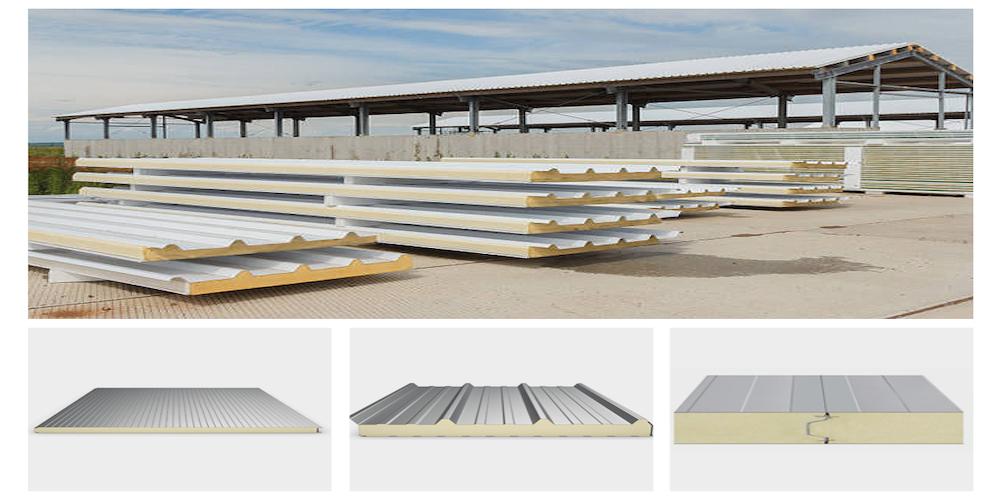
Common Defects and Troubleshooting of Continuous PU Sandwich Panels with Pentane Blowing System (一)
With the gradual phase-out of HCFC-141b, pentane has gradually become a mainstream blowing agent in the continuous panel industry.What problems will be encountered during the production of continuous PUR panel using pentane as the blowing agent?Let us take a look at the common defects and corresponding solutions.
1. Insufficient Foaming / High Density
Phenomenon:Heavy panels, brittle and hard foam, incomplete foam filling.
Causes:Rapid volatilization of pentane, low material temperature, insufficient catalyst activity, excessively high isocyanate index.
Solutions:
· Maintain temperature of polyol and isocyanate at 20–25℃, ambient temperature above 18℃.
· Verify catalyst dosage, especially gel catalysts.
· Control isocyanate index (1.05–1.10 recommended for common flame-retardant panels).
2. Excessive Foaming / Low Density
Phenomenon:Overly soft foam, poor mechanical strength, reduced closed-cell ratio.
Causes:Excessive pentane or water content, high ambient temperature, slow reaction rate.
Solutions:
· Keep pentane dosage within reasonable range (normally 10–14%).
· Improve catalyst activity or reduce material temperature in summer.
3. Bubbles & Pinholes
Phenomenon:Small pores appear inside or on the foam surface.
Causes:Excessive moisture content, insufficient mixing, contamination from mold release agent and other impurities.
Solutions:
· Control moisture content in polyol component.
· Check for clogging in static mixer.
· Avoid contamination, especially silicone oil impurities.
4. Surface Bulging
Phenomenon:Local protrusions on panel surface.
Causes:Mismatched foaming rate and curing rate, localized overheating, concentrated gas release.
Solutions:
· Adjust catalytic system to balance cream time and tack-free time.
· Check over-high temperature of upper and lower facing materials.
5. Dimensional Shrinkage
Phenomenon:Panel length and width shrink obviously after cooling.
Causes:Excessive foaming, insufficient post-curing, rapid cooling.
Solutions:
· Reduce pentane and water dosage, or increase isocyanate index.
· Raise post-curing temperature (50–60℃ insulation recommended).
6. Poor Adhesion (Delamination between Foam and Facings)
Phenomenon:Debonding between foam and glass fiber cloth / color steel sheet.
Causes: Oil contamination or oxidation on facing surface, poor wettability of composite material, insufficient foaming pressure.
Solutions:
· Clean or conduct corona treatment on metal facings.
· Add 1–2% tackifying resin (e.g. terpene phenolic resin).
· Increase material injection volume to elevate internal pressure.
7. Foam Shrinkage (Edge Collapse)
Phenomenon: Inward depression at panel edges.
Causes: Low closed-cell ratio, pentane leakage, insufficient post-curing.
Solutions:
· Increase silicone surfactant dosage (1.5–2.5% recommended).
· Extend thermal insulation in post-curing section.
8. Internal Layer Separation
Phenomenon: Layered cracking inside foam along thickness direction.
Causes: Pressure fluctuation at mixing head, excessively short cream time.
Solutions:
· Stabilize mixing head pressure at 120–150 bar.
· Control cream time within optimal range of 15–25 seconds.
9. Core Burning (Yellowing & Brittle Core)
Phenomenon: Central area of thick panels yellows and becomes brittle.
Causes: Excessively high internal temperature, over-active catalysts, concentrated exothermic reaction of pentane.
Solutions:
· Reduce catalyst dosage.
· Adopt low-exothermic formula for thick panels (>150 mm).