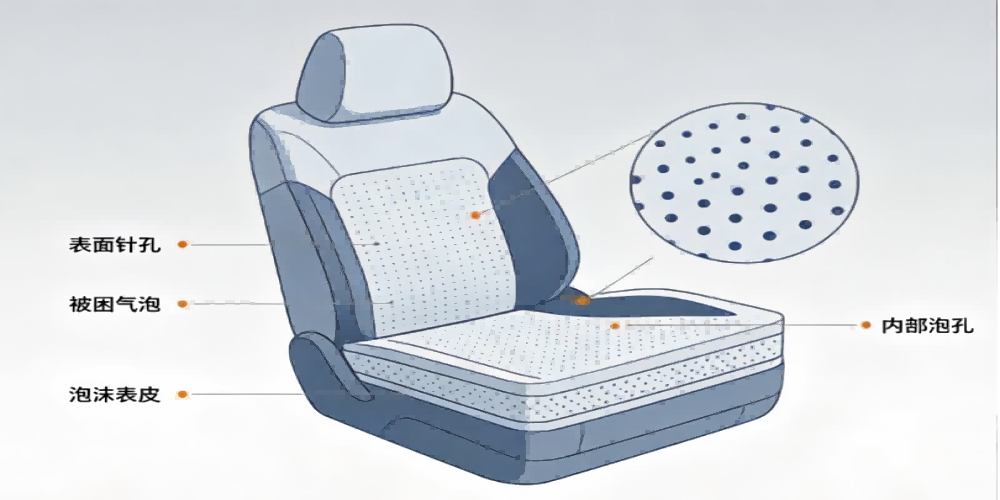
Tiny pinholes all over the car seat foam! What's going wrong?
Tiny pinholes all over the car seat foam! What's going wrong?
During the production of car seat foam, tiny pinholes often appear on the surface, which is a common defect in the industry. This issue doesn’t affect the foam’s internal rebound, but it can ruin the smoothness of the surface, causing defects in later covering or painting processes, and directly lowering product yield. The main cause of pinholes is that the foam cures faster than the gases can escape, trapping air and reaction gases in the surface layer, which then harden into tiny holes. This usually happens at four key process points.
1. Raw material moisture exceeds the limit (most common reason)
The moisture in PU foaming raw materials reacts with isocyanates to produce carbon dioxide. If the polyether raw materials absorb moisture, additives contain water, or the workshop environment is humid and the mold has residual steam, it can cause too much gas to be generated during the foaming process. The excess gas can't escape in time, accumulating on the surface and forming dense pinholes, and this problem gets much worse in humid weather.
2. Imbalance in Catalyst Ratio
Adding too much gel catalyst can cause foaming and gel reactions to get out of sync. Before the foam levels out completely and the internal bubbles escape, the surface skin hardens prematurely and traps the gas inside, resulting in small, uniform pinholes. At the same time, the sponge surface tends to be harder and more brittle.
3. Poor Mold Venting
If the mold vents are blocked, the vent grooves are poorly designed, or the mold closes too quickly, the air inside the mold cavity can't escape fast enough and gets trapped in the foaming material. Once the material hardens, the trapped air forms dense pinholes, mostly around the mold's corners and dead spots.
4. Improper Use of Release Agents
If the release agent is sprayed too thickly, unevenly applied, or contains too much water or oil, it can form a barrier on the mold surface. This blocks the gas from escaping and messes with the foam’s leveling, leading to surface pinholes.
Summary
For seat sponge pinhole issues, there’s no need to blindly tweak the equipment. Focus first on four key areas: raw material moisture content, catalyst ratio, mold ventilation, and release agent process. In daily production, keeping raw materials dry, calibrating formulas, regularly cleaning vent holes, and properly spraying release agents can greatly reduce pinholes and stabilize product quality.
In recent years, Qichen has been focusing on developing Blend Polyols for car seats, providing customers with customized materials while also offering all kinds of technical guidance.